
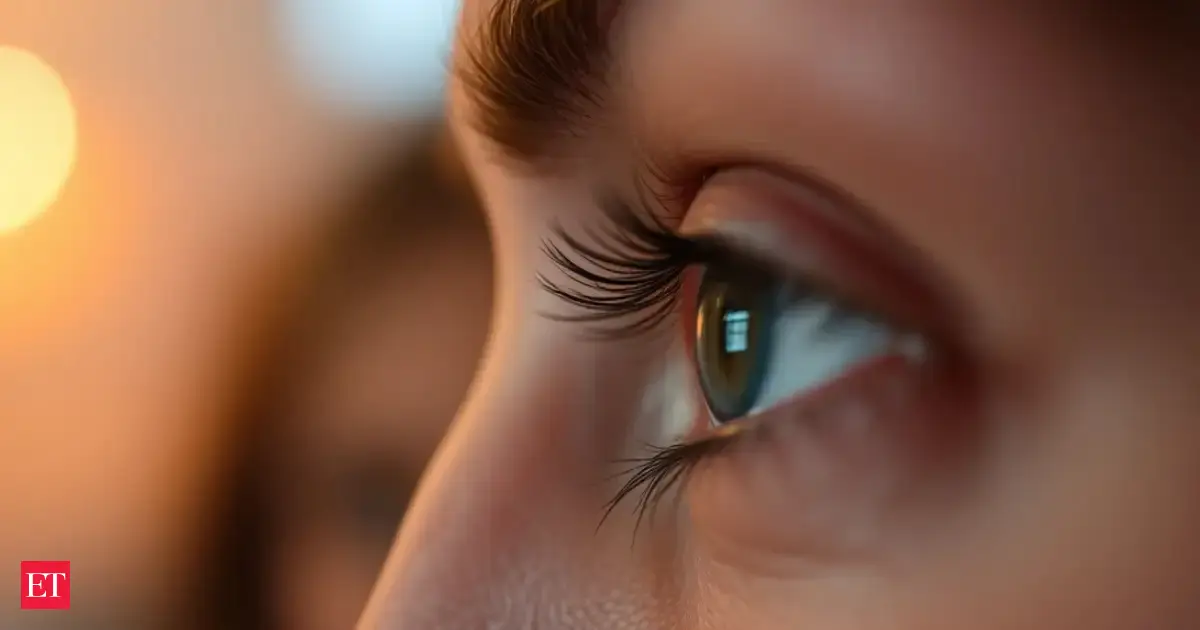
South Korean scientists designed a new AI model that predicts age using retinal images. Published in GeroScience, the study showed a link between a higher retinal age gap and factors like smoking and diabetes. Researchers said, "The results point to an association that could become useful for studying ageing."
Synopsis
A new artificial intelligence model can predict age based on retinal images. The model has identified a retinal age gap associated with health and lifestyle factors. People with certain conditions showed a higher retinal age gap in the study. Researchers emphasize the need for further studies to validate the model's reliability for individual assessments. Ultimately, the technology could provide insights into general health through retinal examinations.
A photograph taken during a routine eye examination could contain information that has little to do with whether you need glasses.
South Korean scientists have managed to design a new artificial intelligence system capable of determining a person's age using an image of his or her retina, which is a layer of cells lining the back part of the human eye.
However, more interestingly, the discrepancy between the age indicated by the image and the real age of an individual correlated with several factors, including health-related ones.
Could it mean that the human retina could be used to determine the pace of ageing?
Live Events
The recent research carried out by scientists at Seoul National University, and published in the journal GeroScience, extends the use of a method called the retinal age gap (RAG). The approach differs from asking people for their age in that it examines whether a person's retina is younger or older than his or her chronological age.
The distinction is important. The researchers are not claiming that an eye photograph can currently determine an individual's biological age. Their results point to an association that could become useful for studying ageing, but the technology still needs to be tested over longer periods and against established measures of biological ageing.
For now, the retina is offering researchers another place to look for signs of what happens to the body as the years pass.
The retina could be more than a window into eye health
The retina is unusual compared with many other tissues because it allows researchers to directly photograph structures that would otherwise be difficult to observe without invasive procedures.
Its network of tiny blood vessels and nerve tissue has already made retinal imaging useful in the diagnosis and monitoring of several eye conditions. Researchers have also been investigating whether changes visible in the retina can reflect broader processes taking place elsewhere in the body.
That makes it an attractive target for artificial intelligence.
Instead of asking a computer to diagnose one specific condition, retinal age models are trained to recognise patterns associated with ageing. Once trained on thousands of images, the algorithm can estimate the chronological age represented by a new retinal photograph.
The latest research expanded the training material used in earlier models. The researchers included retinal images from people with healthy eyes as well as participants with retinal and optic nerve diseases.
In total, 29,530 retinal scans from 7,535 participants were used to develop the model. Another 14,832 scans from 7,416 participants were used to evaluate its performance.
The model estimated chronological age with an average error of around 2.5 to 2.7 years, suggesting that the updated system could compete with or improve on earlier retinal age prediction approaches.
But predicting someone's birthday age was only part of the experiment.
What happens when your retinal age does not match your real age?
They were especially curious about the age difference in retinas.
Consider two people who are 60 years old. The algorithm might predict their retinal ages of retinas to be 59 and 64, respectively.
Those differences could potentially contain information about variation in ageing.
In the study, larger RAG values were associated with several health and lifestyle characteristics.
People with diabetes had a retinal age gap that was 2.52 years higher in the analysis. Current smokers had a 0.5-year higher RAG, while former smokers had a 0.46-year higher gap.
The researchers also identified associations with some eye diseases. Macular degeneration was associated with a 0.6-year higher RAG, while cataracts were linked to a 1.86-year higher gap.
Those figures should not be interpreted as predictions of how many years a person's body has “aged”. They represent statistical associations observed within the study.
There is an additional complication with cataracts. Because cataracts can make retinal photographs less clear, the researchers say the higher age estimates could partly result from image quality rather than accelerated retinal ageing.
That illustrates one of the challenges facing this technology: an algorithm can detect a pattern without necessarily revealing what biological process caused it.
Why diabetes and smoking showed up in the retinal data
The connection between retinal images and wider health is one reason this research has attracted interest.
Diabetes, for example, can affect blood vessels in the retina, while smoking is associated with a range of vascular and age-related health effects. Such changes could leave visual signatures that an algorithm learns to recognise.
But this does not mean the AI is independently measuring every aspect of biological ageing.
A retinal photograph contains a limited snapshot of the body. The algorithm may be responding to a mixture of age-related changes, disease-related changes, image quality and other characteristics present in the training data.
That is why the researchers have been careful about how the results should currently be used.
The study did not compare RAG directly with other established approaches to biological-age measurement. As a result, researchers cannot yet say that retinal age is a superior or equivalent measure of biological ageing.
The study instead provides evidence that the retinal age gap is associated with several factors that are themselves connected with health and ageing.
That is an important distinction if the technology is eventually considered for use in clinics.
The real test will be whether retinal age changes over time
A single retinal photograph can show what an eye looks like at one point in time. To establish whether it can genuinely track biological ageing, researchers need something more demanding: repeated measurements.
Longitudinal studies could photograph the same participants over several years and examine whether changes in their retinal age gap correspond with changes in health.
Researchers could also compare RAG with blood-based biomarkers and other established methods used to investigate biological ageing.
That would help answer a fundamental question: is retinal age actually measuring biological ageing, or is it mainly reflecting changes associated with eye disease and other health conditions?
The researchers also point to improvements in the AI model itself. Their work used a form of multi-task learning, allowing the system to consider age alongside sex rather than treating these characteristics entirely separately. The approach may help reduce some prediction errors arising from differences in the data.
Another potential use could be in ophthalmology clinics. If the technology is eventually validated, a retinal image already being taken for an eye examination could potentially provide an additional signal that prompts doctors to investigate broader health concerns.
But that possibility remains ahead of the evidence.
The researchers emphasise that RAG is currently better suited to population-level research than individual health-risk assessment. The size of the observed associations can also be small relative to the model's prediction error.
In other words, someone should not look at a retinal-age estimate and assume it represents a definitive measure of how well or poorly their body is ageing.
The more interesting prospect is what happens next.
If future studies show that retinal age changes consistently alongside established biological markers, disease progression or responses to treatment, a simple eye image could become a useful source of information about ageing beyond the eye itself.
For now, the study offers a clue rather than a final test. The retina may carry traces of ageing that artificial intelligence can detect before researchers fully understand what those patterns mean.
And that leaves the central question open: when an algorithm says your eyes look older than you are, is it seeing ageing itself—or simply the fingerprints that ageing and disease leave behind?
FAQ
1. What is retinal age?
Retinal Age is an estimate of age by an AI algorithm that detects age patterns from retinal photographs. This type of model uses datasets consisting of many retinal images to be trained.2. What does a retinal age gap mean?
The retinal age gap, or RAG, is the difference between the age estimated from a retinal photograph and a person's actual chronological age. A positive RAG means the model has estimated the retina as older than the person's chronological age.
3. Does a higher retinal age mean someone is ageing faster?
Not necessarily. The study found associations between larger RAG values and factors including diabetes, smoking and some eye diseases. However, the researchers say more evidence is needed to establish whether RAG is a reliable measure of biological ageing.
4. Can this retinal scan currently tell someone their biological age?
No. The technology is still being investigated. The researchers say it currently has greater potential for population-level analysis than individual health-risk assessment. Long-term studies and comparisons with established biological-age biomarkers are needed before it can be considered a dependable individual test.
(You can now subscribe to our Economic Times WhatsApp channel)
Explore More Stories
Psychology explains why people who dislike being interrupted may be protecting more than just their train of thought
Powerball jackpot climbs to $313 million for September 21 drawing - Here's what Monday night's winner could take home
Quote of the Day by Malala Yousafzai: ‘One child, one teacher, one book, one pen can…’ - How one person can spark global change with the simplest tools
Quote of the Day by Thomas Mann: ‘Whoever loves the more is at a disadvantage and must suffer’ - Nobel-winning novelist on why the person who care more may have more to lose
Quote of the Day by Anton Chekhov: ‘Every happy man should have someone with a little hammer at his door to knock and remind him that there are unhappy people, and…’
Gary Myers death: NASCAR legend dies at 76; sons mourn ‘hero’ who shaped four generations of racing
Quote of the day by Rita Wilson: ‘Be fearless in trying new things, whether they are physical, mental…’ – Sleepless in Seattle actress on turning fear into growth
Manager keeps booking 4:45 PM Friday meetings despite team logging off at 5, employee calls it a ‘Friday ambush’ and asks if it’s a power move
New employee moved an old office chair for a meeting and 3 coworkers immediately shouted ‘not that one’; months later, nobody can explain the rule but the manager warned him not to ask the boss
Quote of the Day by Angelina Jolie: ‘Love one person, take care of them…’ - life lessons on love, family, friendship and finding what you truly love from the Oscar-winning actress and filmmaker
Why yelling at your dog may affect more than their mood: Research suggests angry or excited voices can trigger measurable physical changes, revealing how deeply dogs process human emotion
Kim Jong Un is threatening US, Japan and South Korea with its most advanced warship, a 5000-ton nuclear missile carrying destroyers; second warship commissioned as rivals launch drills
Quote of the day by Franz Kafka: ‘The truth is always an abyss. One must, as in a swimming pool, dare to…’ – ‘The Metamorphosis’ author on the difficult journey from everyday reality to deeper truth