
A review published in the journal Coatings on Sep 28 2026 examined how essential-oil nanocoatings keep food fresh. These films reduced spoilage bacteria in meat and dairy products. However, researchers said, "increasing the NE concentration above 2% did not further improve antimicrobial activity," showing that more oil is not always better.
By Samudrapom DamReviewed by Susha Cheriyedath, M.Sc.Sep 28 2026
A new review traces how essential-oil nanoemulsions behave inside biopolymer films across meat, dairy, and produce, while examining the factors that could shape their future use in food packaging.
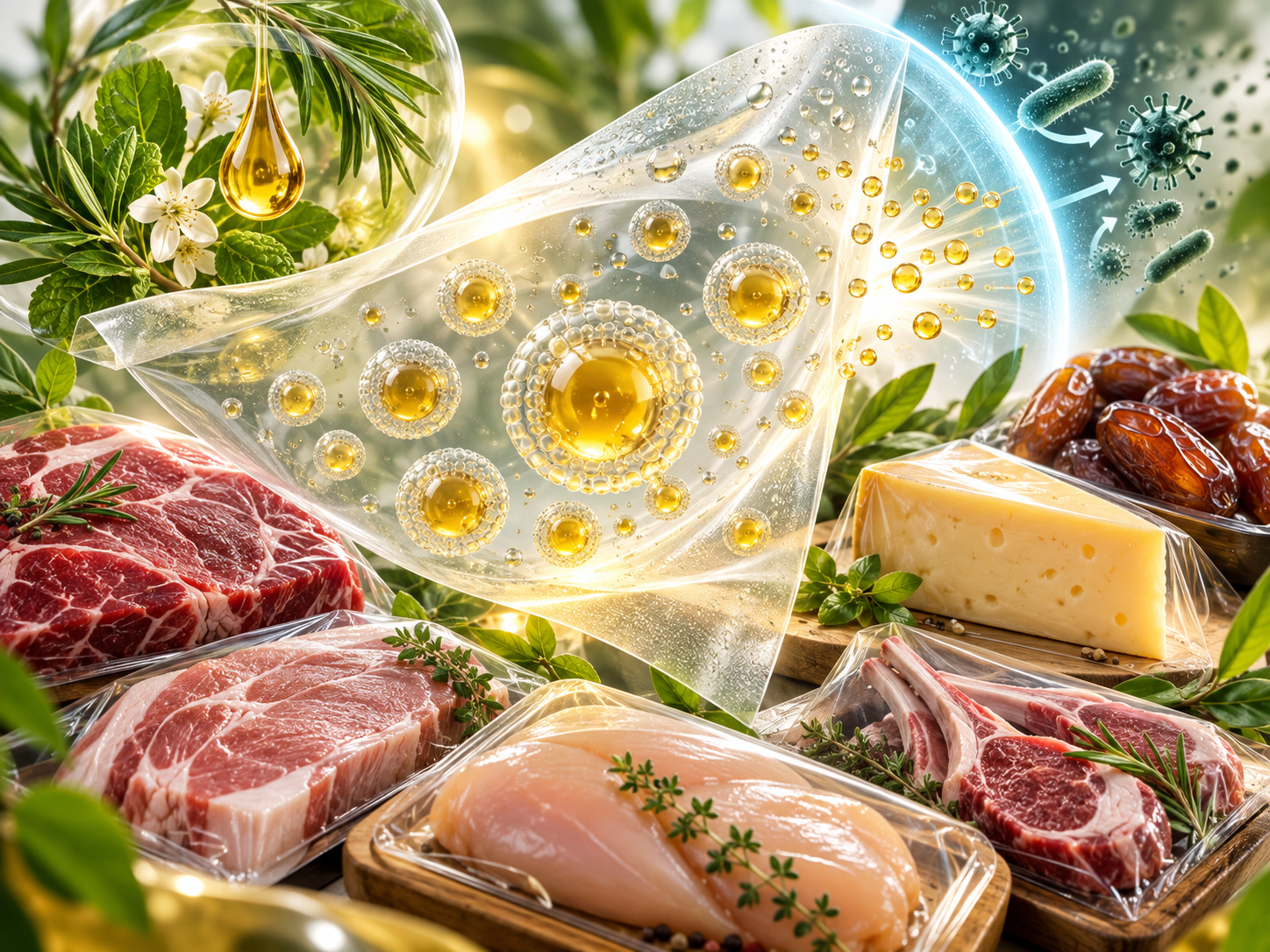
Paper: Nanoemulsion-Based Nanocoatings Containing Essential Oils for Active Packaging: Production Technologies, Characterization and Microbial Control. AI-generated abstract conceptual image created using ChatGPT/OpenAI
Want to read later? Download your clean, ad-free, print-friendly PDF copy by clicking here.
A review recently published in the journal Coatings critically examined nanoemulsion (NE)-based nanocoatings containing volatile plant-derived oils (EOs) for active packaging.
The authors conducted a structured literature search and included 27 original English-language studies published from 2020 onward in a narrative synthesis. They did not conduct a formal risk-of-bias assessment or a meta-analysis, so the findings are best interpreted as recurring trends and mechanistic relationships rather than pooled effect estimates.
Physical, barrier, and optical properties
Water solubility also fell progressively, indicating that the films became less water-sensitive, particularly from the intermediate concentration onward.
Chitosan films containing thyme EO NE behaved differently. WVP rose as NE concentration increased, and opacity was higher at 4% than at 1%, after a small dip at 2%.
At higher NE concentrations, WVP increased above the control. Visible-light transmittance was initially higher at 0.5% and 1.0% NE, then fell sharply at 1.5% and 2%.
These findings show that changes in barrier properties are shaped by NE concentration, the nature of the polymer matrix, and interactions between the dispersed phase and the film-forming network.
NE-enriched nanocoatings for microbial control
Across the studies reviewed, NE-enriched nanocoatings reduced spoilage microorganisms and foodborne pathogens in several food matrices. Sodium alginate nanocoatings containing myrtle EO NEs reduced viable Listeria monocytogenes counts during refrigerated storage of Kasar cheese, while untreated samples showed progressive microbial growth.
Fresh meat products also showed microbial control. Chitosan films containing thyme EO NEs delayed the growth of Escherichia coli and Bacillus subtilis in refrigerated beef, extending shelf life to six days.
In that thyme/chitosan study, increasing the NE concentration above 2% did not further improve antimicrobial activity. More encapsulated oil did not automatically produce better microbial control.
Gelatin-chitosan edible films containing kesum EO NEs prolonged the refrigerated shelf life of minced beef from about 3 to 12 days while keeping Enterobacteriaceae and total viable counts within acceptable microbiological limits.
In chicken meat, starch coatings loaded with Zataria multiflora EO NEs substantially reduced populations of spoilage microorganisms and L. monocytogenes, especially when cinnamaldehyde was included in the formulation.
In mutton, cress seed gum coatings with Dracocephalum moldavica EO NEs reduced Enterobacteriaceae and spoilage fungi during refrigerated storage, but total bacterial counts still rose at all NE concentrations.
Impacts on food-matrix sensory properties
Chitosan-based active films containing lemon EO NEs helped preserve the freshness of refrigerated pork. Samples treated with 1.5% and 2% NE had better textural characteristics at the end of storage because controlled release of bioactive agents limited muscle fiber degradation.
At the intermediate and final stages of storage, active films reduced liquid loss in the pork samples. In a separate study, coated dates were associated with less weight loss than the control group. Hardness rose in the control as moisture was lost, supporting the coating's moisture-retention capacity.
In turkey meat, a sage seed gum coating containing lemon verbena EO NE improved sensory quality after 16 days of storage, including texture, color, odor, and overall acceptability.
The sensory quality of refrigerated mutton was maintained with an active cress seed gum (CSG) coating containing 1% and 1.5% Dracocephalum moldavica oil nanoemulsion (DMNEO) over a 12-day storage period.
These two concentrations maintained better odor and color attributes than the untreated control. They also slowed the decline in overall acceptability and helped retain natural texture during refrigerated storage. Kasar cheese showed the sensory trade-off more clearly. Myrtle EO coatings improved color and appearance, but flavor and overall acceptability fell as EO concentration rose. The 2% coating had the lowest acceptance score, 5.11, which the source study attributed to the strong flavor and odor of myrtle oil.
EO concentration remains a major factor in food acceptability. Formulations need to balance the minimum concentration required for satisfactory antimicrobial activity with consumer sensory acceptance.
Trends for development and application
The review links growing demand for sustainable preservation technologies with further development of biodegradable NE-based nanocoatings containing EOs.
These systems combine the antimicrobial properties of natural phytochemicals with the technological advantages of nanostructured delivery, offering potential alternatives to synthetic preservatives.
Industrial use still faces key scientific and technological challenges. Future research should refine formulation composition and processing conditions, with close attention to oil-polymer interactions rather than simply reducing droplet size.
Standardized preparation and characterization methods are also needed to allow comparisons among studies and support scale-up. Scale-up work should aim to maintain NE stability while lowering production costs and energy use.
Studies should also address consumer acceptance, regulatory compliance, stability, sensory quality, shelf-life prediction, and environmental impacts. Commercial use also calls for application-specific assessment of migration, consumer exposure, toxicological safety, labeling, and applicable regulatory rules. The review calls for further toxicological studies before commercial viability can be established.