
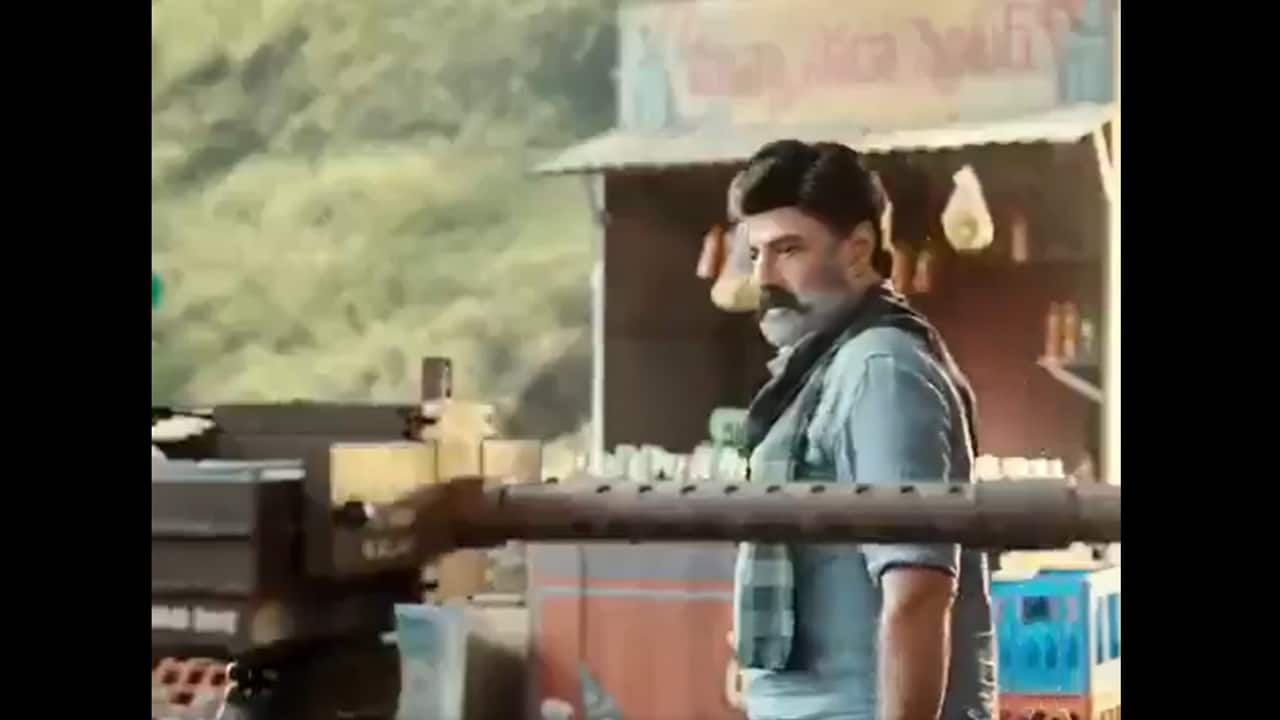
The Iranian Embassy in Zimbabwe shared a fight clip from the Telugu film 'Bhagavanth Kesari' on September 23, 2026, to mock Donald Trump. The embassy wrote, "Trump talks about annihilating Iran. But he knows Iran is not defenceless." Many social media users noted the film is Telugu, not Bollywood.
In its latest jibe at US President Donald Trump, Iran has turned to Telugu cinema, sharing a fight sequence featuring actor Nandamuri Balakrishna from Bhagavanth Kesari after Trump threatened to "annihilate" the Islamic Republic if no deal is reached. The 58-second video was posted on microblogging site X by the Iranian Embassy in Zimbabwe. It shows Balakrishna's character taking on a group of armed men in a high-octane fight sequence, including scenes in which he uses a manhole cover to shield himself before fighting back. "Trump talks about annihilating Iran. But he knows Iran is not defenceless," the embassy wrote while sharing the clip. "Since we informed they have recently been watching Bollywood instead of Hollywood," it further wrote in the post. Trump talks about annihilating Iran. But he knows Iran is not defenseless. Since we informed they have recently been watching Bollywood instead of Hollywood. pic.twitter.com/v6Le8zkH5X -- Iran Embassy in Zimbabwe (@IRANinZIMBABWE) September 23, 2026 The post has since drawn attention on social media, with users pointing out that Bhagavanth Kesari is a Telugu-language film and not a Bollywood production. The video has also received reactions from Balakrishna and Telugu cinema fans, who pointed to the film's Telugu origins. The unusual social media response came shortly after Trump used his address to the United Nations General Assembly to issue a fresh warning to Tehran. "I have a big decision to make. Will a deal be made with Iran that lets them rebuild and create a far greater country than it ever was before? ... Or do I annihilate the Islamic Republic, and do it quickly," Trump said in his UNGA address. Trump also said he believed a deal could be reached, even as Washington and Tehran remained locked in a confrontation over the continuation of the conflict and a range of other issues. Iranian Foreign Ministry spokesperson Esmail Baghaei separately criticised Trump's remarks, arguing that the US president's repeated accusations against Tehran reflected what he described as "desperation" rather than authority. "One of these nuances was the US President's speech," Baghaei said in an interview with Iranian state news agency IRNA. "The nuances are because the remarks made by the US President regarding the Islamic Republic of Iran were repetitive claims and accusations." Baghaei also criticised Trump for using the UN General Assembly as a platform to threaten military action. "The fact that you are turning the United Nations General Assembly, the largest international assembly, into a stage for making statements that are absolutely illegal, contrary to international law and diplomatic custom, is not a sign of authority," he said. He further defended Iran's decision to maintain a presence during Trump's speech, saying the country's seat at the UN remained an important diplomatic platform. "Iran's seat in a place like the UN General Assembly is our stronghold," Baghaei said, according to IRNA. Iranian military authorities also responded to Trump's remarks, saying repeated threats against Tehran did not change what they described as the strategic balance between the two countries. Despite the public exchange of threats and criticism, diplomatic contacts between Washington and Tehran continued on the sidelines of the UN General Assembly in New York. Baghaei said Iranian and US representatives interacted through Qatari mediation, with Tehran conveying conditions that included an end to the war, a halt to US military actions against Iran, an end to the naval blockade in the Strait of Hormuz and the release of Iranian assets. US Middle East envoy Steve Witkoff also confirmed that talks had taken place through mediators. In a post on X, Witkoff said the two sides had engaged in "lengthy talks" and that the mediators would continue their efforts. Iranian state media reported that Foreign Minister Abbas Araghchi also met Witkoff after receiving a request for discussions. According to the report, Tehran reiterated its conditions for reopening the Strait of Hormuz, including lifting the naval blockade, releasing frozen Iranian assets and ending the conflict on multiple fronts. Trump later confirmed that Witkoff and Jared Kushner were involved in the discussions through mediators. He said the meeting lasted three hours and described it as a "very good meeting". The exchange came as Iranian President Masoud Pezeshkian attended the 81st session of the UN General Assembly in New York. Before he departs for the US, Pezeshkian said Tehran would use international forums to present its position on the conflict and what it described as unfulfilled commitments in previous negotiations.