
Five nominations from India got added to UNESCO's Tentative List of World Heritage on Tuesday. Officials said the list now has 78 sites, including four locations in Madhya Pradesh and a proposal on Satyagraha. These entries show a proud milestone for India as they move toward final heritage status.
Five nominations from India have been added to UNESCO's Tentative List of World Heritage, including four sites in Madhya Pradesh and a serial transnational proposal on places linked to Satyagraha in India and South Africa, officials said on Tuesday.
With these additions, India's UNESCO Tentative List now has 78 sites. PIB Culture, in a post on X, called it a "proud milestone" for the country's heritage and said the new entries are Bagh Cave Paintings, Group of Temples of the Chambal Valley, FCaves, Ginnorgarh, and the India-South Africa serial transnational proposal, Sites of Satyagraha.
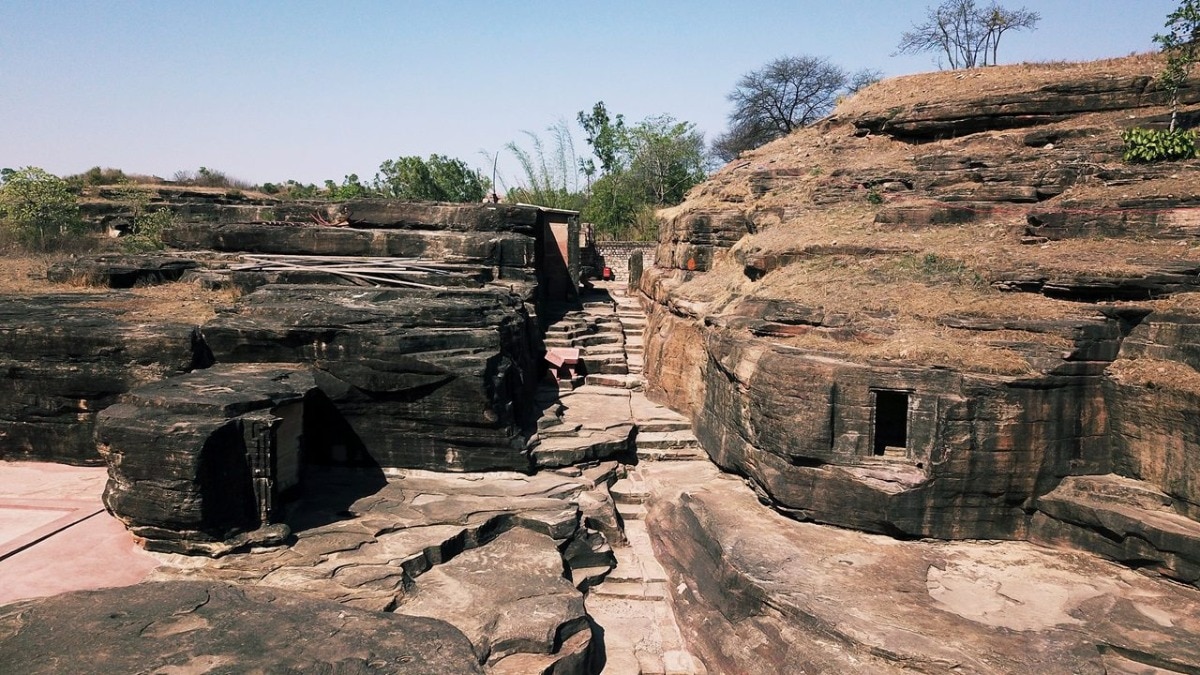
According to the UNESCO website, Udayagiri hill in Madhya Pradesh contains a rock-cut sacred ensemble developed mainly under Gupta patronage between the late 4th and early 5th centuries.
The site includes 20 excavated caves, sculptural panels, inscriptions, circulation paths, rock surfaces bearing early marks and inscriptions, and associated topographical and hydrological features that together form an integrated ritual landscape.
The Bagh caves are a group of nine rock-cut Buddhist caves on the southern slope of the Vindhyan range on the banks of the Baghni river in western Madhya Pradesh. UNESCO says these caves are the only outcrop of sandstone in an otherwise basaltic region, a factor that influenced their architectural forms and the preservation of mural paintings.
Ginnorgarh Fort, described as the principal fortified capital of the erstwhile Raj Gond rulers in central India, and the Group of Temples of the Chambal Valley - Bateshwar, Padavali and Kakarmath - have also been added to the list.
A site must first be placed on the UNESCO Tentative List before it can be considered for World Heritage status.
The fifth addition is a proposed serial transnational property that traces the evolution of Mahatma Gandhi's idea of Satyagraha, from its conceptualisation in South Africa to its experimentation, consolidation and institutionalisation in India.
UNESCO says the proposed property includes nine components - two in South Africa, where Gandhi spent 21 years from 1893 to 1914, and seven in India, where he spent most of his life.
The nine components are Pietermaritzburg station and the Phoenix Settlement in South Africa; and the Mahatma Gandhi Satyagraha Smarak, the Sabarmati Ashram, the Mani Bhavan complex, the Harijan Sevak Sangh complex, the Sevagram Ashram, the Aga Khan Palace and the Gandhi Smriti residence in India.
UNESCO says these components represent the evolution of Satyagraha from its inception as a response to racial discrimination at Pietermaritzburg Station, to an exploratory phase linked to communities committed to truth and non-violence at Phoenix Settlement, then to consolidation in India through sites such as Mahatma Gandhi Satyagraha Smarak, Sabarmati Ashram and Mani Bhavan, and finally to its institutionalisation through Harijan Sevak Sangh, Sevagram, Aga Khan Palace and Gandhi Smriti.